

You have heard the term “family office” without being quite sure what it covers. That’s understandable: there is no legal definition of a family office under Swiss law. Private banks, wealth managers, luxury concierge services, estate advisors—everyone lays claim to it. The term “family office” is essentially a commercial designation, not a legal qualification. This guide explains what a family office actually is, how its different models work, and how to choose the right structure for your situation in Switzerland.
Definition: what is a family office?
A family office is a structure dedicated to the comprehensive management of a wealthy family’s assets. Its role extends well beyond financial management: it organises, oversees, and coordinates all the expertise required—banking, financial, legal, tax, succession, real estate, philanthropic—to serve the family’s interests as a whole.
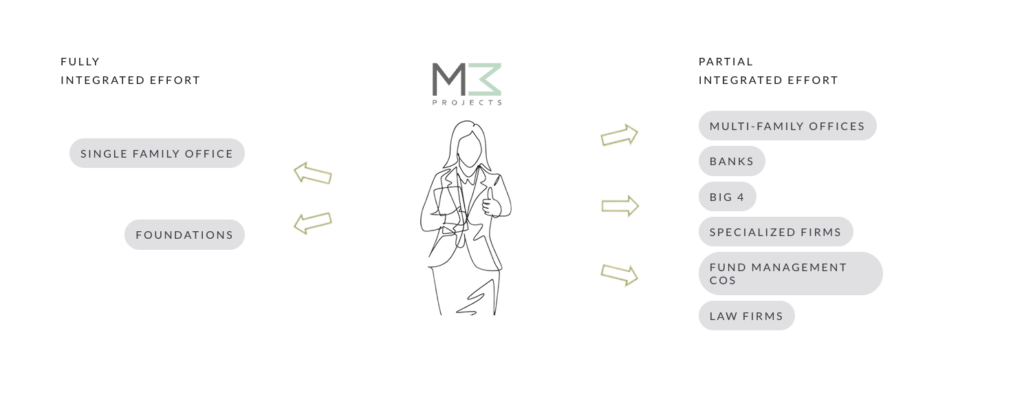
What a family office does in practice
A family office can cover a very broad scope of activities:
- Managing and coordinating specialists (bankers, investment managers, tax advisors, notaries, lawyers)
- Succession planning and family governance
- Regular consolidated reporting (assets, income, expenses)
- Managing complex personal projects from start to finish (acquisitions, construction, business creation)
- Risk management and compliance
- Supporting the next generation (heirs)
What a family office does not do
A family office is not a bank. It does not hold client deposits—those remain with custodian banks. In many cases, it does not directly manage portfolios either. The family office supervises these relationships but does not replace the banking infrastructure. Its value lies elsewhere: in organising and overseeing asset management, governance, execution, and protecting the family’s interests in complex environments.
The different types of family office
Three main models exist. They do not serve the same profiles and do not offer the same independence guarantees.
The Single Family Office (SFO)
A single family office is a structure created exclusively by and for one family. It employs dedicated professionals who work solely for that family—functioning as an executive management for all family assets.
Advantages: maximum personalisation, total confidentiality, complete alignment with family interests.
Constraints: high fixed costs (a structured SFO typically runs to several million francs per year) and a minimum asset threshold to justify the structure—generally several hundred million Swiss francs, or even a billion.
The Multi Family Office (MFO)
A multi family office pools its services across several client families. Each family benefits from professional expertise and tools, while sharing the cost structure with others.
Advantages: access to SFO-level expertise at significantly lower cost.
Watch out for: conflicts of interest when families have diverging interests, or when the MFO is affiliated with a financial institution that has its own products to place. The provider’s real independence is the first criterion to verify.
The Virtual Family Office
The virtual family office outsources all services to specialist providers (bank, investment manager, lawyer, tax advisor, notary, real estate expert), coordinated by a central project lead. This is the most flexible model, suited to substantial assets that have not yet reached SFO thresholds.
Advantages: high flexibility, access to the best specialists as needs arise, without heavy fixed costs.
Constraints: the model’s quality depends entirely on the central project lead’s coordination skills and independence from the providers they recommend.
Bank-affiliated vs. independent family office: a critical distinction
This is the most important question to ask before choosing a provider—and the one asked least often.
A family office affiliated with a private bank, an insurer, or a large firm is not structurally independent. Its remuneration may include commissions on recommended financial products or retrocessions on mandates it directs. This is not always problematic, but it creates a potential bias in the advice given.
What independence actually guarantees
A truly independent family office works exclusively for its client, with no products to place and no remuneration tied to a recommendation. Its only source of income is the fee paid by the family. This structure aligns its interests completely with the client’s.
In practice, this changes the nature of advice. An independent provider can recommend against setting up a complex tax structure if it does not serve the client’s interests. A provider remunerated on implementation will tend to recommend the structure regardless.
Family office in Switzerland: a specific market
Switzerland—and French-speaking Switzerland in particular—is one of the most developed markets in the world for private wealth management. Geneva, Lausanne, and Pully concentrate an exceptional density of legal, tax, and financial specialists, making them a natural environment for family office structures.
The Swiss regulatory framework
In Switzerland, wealth management activities are overseen by FINMA (the Swiss Financial Market Supervisory Authority). Since 2020, independent wealth managers must be subject to direct FINMA supervision or that of a recognised supervisory organisation.
Two types of activity must be distinguished:
- Wealth management in the strict sense (managing financial portfolios on behalf of third parties) requires FINMA authorisation.
- Strategic advice, project management, expert coordination, and asset governance do not constitute wealth management under the regulatory definition and are therefore outside that framework. This is the space in which MB Projects operates.
From what asset level should you consider a family office?
There is no universal threshold. As a general guide, creating an SFO makes sense with assets of several hundred million Swiss francs, or even a billion. An MFO delivers clear value from CHF 10 to 15 million. An independent provider such as a Personal Strategist can add value from CHF 2 million or more, particularly where the asset portfolio is complex (assets located in several countries, estate planning required, personnel projects to manage). The right criterion is not the size of the assets alone, but their complexity and the coordination demands that come with it.
Wealth manager, asset manager, Personal Strategist: what’s the difference?
These terms are often used interchangeably, creating real confusion for clients.
The wealth manager
Their primary role is financial: managing a portfolio of assets (equities, bonds, funds) to generate returns. They do not manage personal projects, coordinate notaries, or typically have expertise in family governance or succession law.
The asset manager
A broader term than wealth manager, this describes a professional whose scope also covers real estate, tax, and sometimes succession. They remain focused on advice—analysing and recommending—but delegate execution to others.
The Personal Strategist
This is a different model. A Personal Strategist does not simply advise—they take charge of execution. They define the roadmap, coordinate the specialists, draft or review legal documents, negotiate contracts, and ensure the project reaches completion, from the first conversation through to delivery.
Importantly, a Personal Strategist does not manage financial portfolios. They coordinate execution, advise strategically, and oversee asset governance—but portfolio management remains with specialist managers.
The difference is not semantic. An advisor delivers a report. A Personal Strategist gets things done.
How to choose your family office or Personal Strategist
Five questions to ask before entrusting your asset management to a third party.
1. Are they genuinely independent?
Ask directly: what is your fee structure? Do you receive commissions or retrocessions tied to your recommendations? An independent provider charges fees only, with no hidden remuneration.
2. What is their real execution capacity?
The difference between a good advisor and a good provider is what happens after the meeting. Ask for concrete examples of projects managed from start to finish. A provider who only offers theoretical advice will not move your projects forward.
3. Do they understand your environment?
Knowledge of the local context—political, institutional, cultural, fiscal—is essential for navigating complex environments. A provider who knows French-speaking Switzerland, its actors, and its institutions will deliver considerably more value than a generalist.
4. How do they manage conflicts of interest?
Conflicts of interest in this sector are common and not always visible. A family office affiliated with a bank, a firm, or an insurer has institutional interests that may diverge from yours. Ask the question directly.
5. What is their approach to confidentiality?
In this sector, confidentiality is non-negotiable. Ask how the provider protects client information and with whom they share data (partners, providers, institutions).
Managing complex assets takes more than a good portfolio
It requires a global perspective, coordination capacity, and a provider whose interests are fully aligned with yours.
At MB Projects, we work as Personal Strategist for families and entrepreneurs who want to turn their personal projects into concrete, structured realities—from the first conversation through to delivery.
If you have questions about your asset situation or would like to discuss a specific project, contact us directly.